Store: Haney Builders, Maple Ridge
0 CAD 0.00
items in your cartto quote To cart
Ooops no items were found.
Try something else.
Ok
Loading…

The Complete Guide to Concrete Blocks: Building Stronger, Smarter Outdoor Spaces

Concrete blocks are one of the most versatile building materials available — quietly holding up basements, retaining walls, garden beds, and property lines all over North America. If you're planning a construction or landscaping project this season, understanding the different types of concrete block available (and which one fits your project) will save you time, money, and headaches.

Here's your practical guide to concrete blocks, straight from the yard.

Why Concrete Block Is Still the Go-To Material

Concrete blocks (also called CMUs — Concrete Masonry Units) have been a construction staple for over a century, and for good reason:

- Strength and durability — concrete block structures can last 100+ years with minimal maintenance
- Fire resistance — unlike wood, block won't burn, making it a safer choice for structural walls
- Cost-effective — lower material and labor costs compared to poured concrete or natural stone
- Design flexibility — available in dozens of sizes, textures, and finishes
- Sound and thermal insulation — dense concrete block dampens noise and helps regulate temperature


The Two Main Categories of Concrete Block

1. Structural Block & Brick

These are your standard building blocks — the workhorses of foundations, basement walls, and load-bearing structures.

Common sizes include:
- 8x8x16" Full Block — the standard for most foundation and structural walls
- 6x8x16" Full Block — used where a slightly thinner wall profile is needed
- 4x8x8" Half Block — ideal for finishing wall ends, corners, and tie-ins

Structural blocks are typically hollow-core, which reduces weight, saves material, and allows for rebar and grout reinforcement — critical for load-bearing walls, foundations, and below-grade construction.

Best for: foundations, basement walls, fire walls, sound barriers, commercial and residential structural construction.


2. Retaining Wall Block

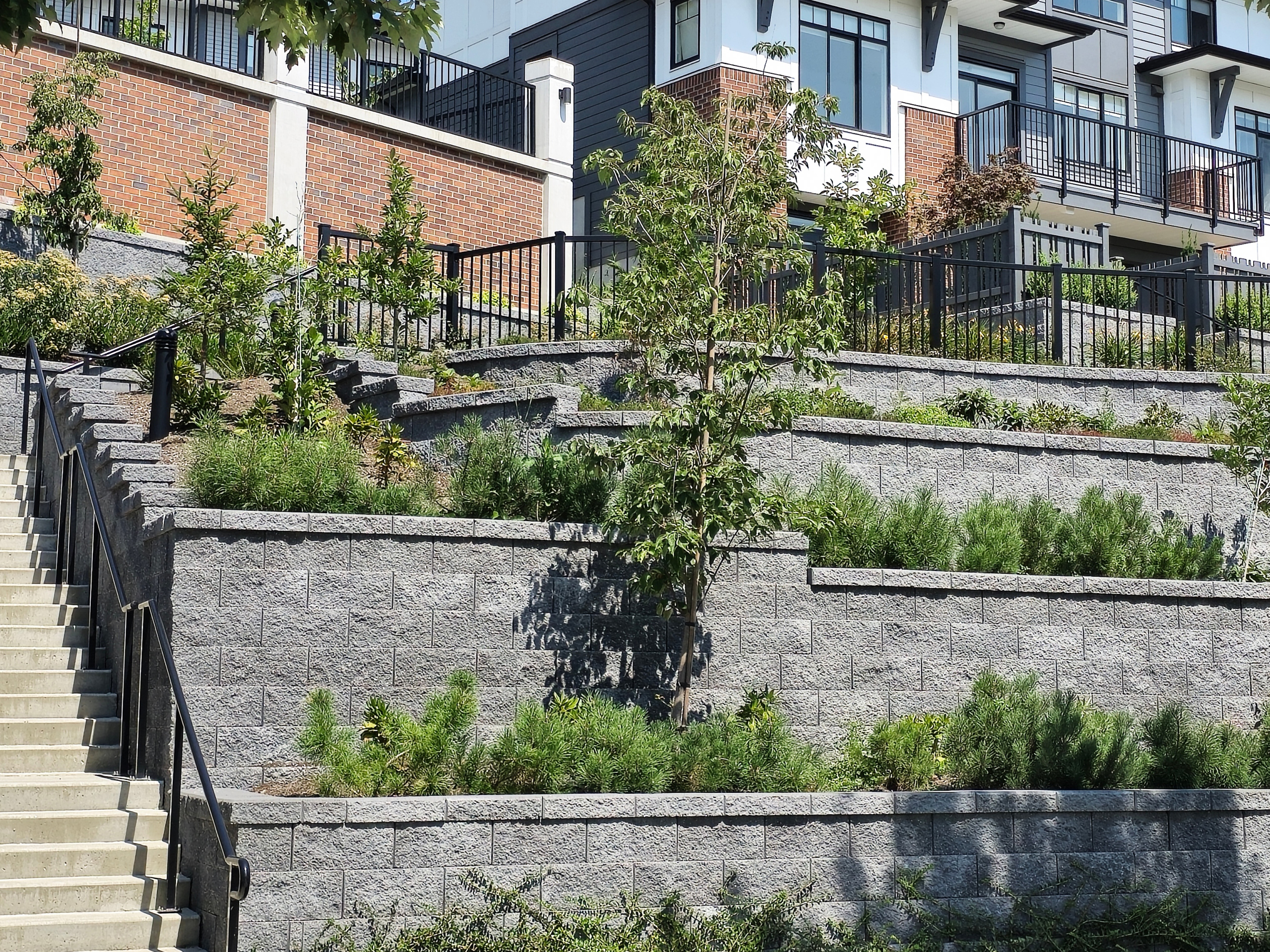
If you're managing a slope, building a raised garden bed, or creating a defined outdoor living space, retaining wall block is purpose-built for the job. Unlike structural block, these are designed as a modular, interlocking system — no mortar required.

Popular systems include:
- Allan Block — a classic split-face interlocking block with a hollow core for easy handling. Available in multiple finishes (like charcoal) and sizes (e.g., 8x16x8"). The interlocking lip system keeps courses aligned as you build up the wall.
- Valley Stone by Basalite — an engineered block with side wings for smoother, faster installation and multiple pinhole positions for setback options, allowing you to build anything from a small garden edge to a taller engineered retaining wall.

Best for: retaining walls, terraced gardens, raised planters, fire pits, outdoor kitchen bases, and any project where you want the strength of concrete with the clean, stacked-stone look.


How to Choose the Right Block for Your Project

| Foundation or basement wall | Structural full/half block (8x8x16" or 6x8x16") |
| Small garden wall or planter (under 3 ft) | Allan Block or Valley Stone retaining block |
| Sloped yard / erosion control | Engineered retaining wall system (check setback specs) |
| Fire-rated or sound-rated wall | Structural CMU block |
| DIY weekend project | Retaining wall block (no mortar, interlocking design) |

A quick rule of thumb: if it's holding up a building, go structural. If it's holding back earth or shaping a landscape, go retaining wall block.


3 Tips for a Successful Block Project

1. Start with a solid base. Whether structural or retaining, every block wall needs a properly compacted gravel or concrete footing. Skipping this step is the #1 cause of wall failure.
2. Mind your setback. For retaining walls over a few courses high, use a system (like Valley Stone) with built-in setback pinholes — this creates the slight backward lean that keeps taller walls stable long-term.
3. Order a little extra. Block is sold by the pallet, and running short mid-project means a delay waiting on restock. Add 5–10% to your estimated count for cuts, corners, and breakage.

Ready to Start Building?

Whether you're pouring a new foundation or building your dream backyard retaining wall, having the right block — in the right quantity — makes all the difference. Our yard stocks a full range of structural block, half block, and retaining wall systems including Allan Block and Valley Stone, with in-store pickup available in as little as 4 hours or delivery within 48 hours.

Browse our full concrete block selection and get a quote today.

Visit us in-store or shop online to find the right block for your next project.

Contact Us

22740 Dewdney Trunk Road,
Maple Ridge, BC, V2X 3K2
CA

6044636206

Contact Us

22740 Dewdney Trunk Road,
Maple Ridge, BC, V2X 3K2
CA

6044636206

The Complete Guide to Concrete Blocks: Building Stronger, Smarter Outdoor Spaces

Concrete blocks are one of the most versatile building materials available — quietly holding up basements, retaining walls, garden beds, and property lines all over North America. If you're planning a construction or landscaping project this season, understanding the different types of concrete block available (and which one fits your project) will save you time, money, and headaches.

Here's your practical guide to concrete blocks, straight from the yard.

Why Concrete Block Is Still the Go-To Material

Concrete blocks (also called CMUs — Concrete Masonry Units) have been a construction staple for over a century, and for good reason:

- Strength and durability — concrete block structures can last 100+ years with minimal maintenance
- Fire resistance — unlike wood, block won't burn, making it a safer choice for structural walls
- Cost-effective — lower material and labor costs compared to poured concrete or natural stone
- Design flexibility — available in dozens of sizes, textures, and finishes
- Sound and thermal insulation — dense concrete block dampens noise and helps regulate temperature


The Two Main Categories of Concrete Block

1. Structural Block & Brick

These are your standard building blocks — the workhorses of foundations, basement walls, and load-bearing structures.

Common sizes include:
- 8x8x16" Full Block — the standard for most foundation and structural walls
- 6x8x16" Full Block — used where a slightly thinner wall profile is needed
- 4x8x8" Half Block — ideal for finishing wall ends, corners, and tie-ins

Structural blocks are typically hollow-core, which reduces weight, saves material, and allows for rebar and grout reinforcement — critical for load-bearing walls, foundations, and below-grade construction.

Best for: foundations, basement walls, fire walls, sound barriers, commercial and residential structural construction.


2. Retaining Wall Block

If you're managing a slope, building a raised garden bed, or creating a defined outdoor living space, retaining wall block is purpose-built for the job. Unlike structural block, these are designed as a modular, interlocking system — no mortar required.

Popular systems include:
- Allan Block — a classic split-face interlocking block with a hollow core for easy handling. Available in multiple finishes (like charcoal) and sizes (e.g., 8x16x8"). The interlocking lip system keeps courses aligned as you build up the wall.
- Valley Stone by Basalite — an engineered block with side wings for smoother, faster installation and multiple pinhole positions for setback options, allowing you to build anything from a small garden edge to a taller engineered retaining wall.

Best for: retaining walls, terraced gardens, raised planters, fire pits, outdoor kitchen bases, and any project where you want the strength of concrete with the clean, stacked-stone look.


How to Choose the Right Block for Your Project

| Foundation or basement wall | Structural full/half block (8x8x16" or 6x8x16") |
| Small garden wall or planter (under 3 ft) | Allan Block or Valley Stone retaining block |
| Sloped yard / erosion control | Engineered retaining wall system (check setback specs) |
| Fire-rated or sound-rated wall | Structural CMU block |
| DIY weekend project | Retaining wall block (no mortar, interlocking design) |

A quick rule of thumb: if it's holding up a building, go structural. If it's holding back earth or shaping a landscape, go retaining wall block.


3 Tips for a Successful Block Project

1. Start with a solid base. Whether structural or retaining, every block wall needs a properly compacted gravel or concrete footing. Skipping this step is the #1 cause of wall failure.
2. Mind your setback. For retaining walls over a few courses high, use a system (like Valley Stone) with built-in setback pinholes — this creates the slight backward lean that keeps taller walls stable long-term.
3. Order a little extra. Block is sold by the pallet, and running short mid-project means a delay waiting on restock. Add 5–10% to your estimated count for cuts, corners, and breakage.

Ready to Start Building?

Whether you're pouring a new foundation or building your dream backyard retaining wall, having the right block — in the right quantity — makes all the difference. Our yard stocks a full range of structural block, half block, and retaining wall systems including Allan Block and Valley Stone, with in-store pickup available in as little as 4 hours or delivery within 48 hours.

Browse our full concrete block selection and get a quote today.

Visit us in-store or shop online to find the right block for your next project.

SEARCH ×

Search